
African Heritage in Puerto Rico
The Roots and Legacy of Afro-Puerto Rican Culture
African heritage is fundamental to Puerto Rican identity.
Beginning in the early Spanish colonial period, enslaved Africans were forcibly brought to Puerto Rico and made to work in mining, agriculture, construction, domestic labor and other parts of the colonial economy. Over generations, Africans and their descendants helped shape the island's music, dance, food, language, spirituality, traditions and community life.
Their story is one of exploitation and slavery, but also of resistance, survival, creativity and cultural transformation. African traditions interacted with Taíno and Spanish influences to help create the Puerto Rican culture we recognize today. The Library of Congress notes that African customs, languages and ideas left an enduring imprint on Puerto Rican language and identity.
Africans Arrive in Puerto Rico
Enslaved Africans were brought to Puerto Rico during the earliest decades of Spanish colonization.
As the Indigenous population was devastated and Spanish colonists expanded agriculture and other economic activity, the transatlantic slave trade became increasingly important to the colonial labor system.
Africans arriving in Puerto Rico came from different regions and peoples rather than from a single African culture. Their languages, beliefs, music, foodways and traditions were diverse.
Slavery in Puerto Rico
Enslaved Africans and their descendants worked throughout Puerto Rican society, particularly in agriculture.
The African presence in Puerto Rico is inseparable from the history of slavery and Spanish colonialism.
Enslaved Africans began arriving during the early decades of Spanish colonization as the Indigenous population declined dramatically because of disease, warfare, forced labor and displacement. Spanish colonists increasingly turned to enslaved African labor to support the colony's economy.
The people brought to Puerto Rico were not members of a single culture. They came from different regions and societies in Africa and brought diverse languages, religious beliefs, musical traditions, foodways and cultural practices with them.
Labor and the Colonial Economy
Enslaved people worked throughout colonial Puerto Rican society.
They labored in sugarcane fields and mills, coffee cultivation, cattle ranches, construction, domestic service and skilled trades. As commercial agriculture expanded, enslaved labor became particularly important to the plantation economy.
Sugar production grew rapidly during the nineteenth century, tying Puerto Rico more closely to the broader Caribbean plantation economy.
But the experiences of enslaved people varied considerably. Plantation slavery, urban slavery and domestic labor created different living and working conditions, while free Black and mixed-race communities also existed alongside the enslaved population.
Resistance and Survival
Enslaved people were never passive participants in this system.
Resistance took many forms. Some escaped. Others challenged owners, maintained family and community networks, preserved elements of African cultural practices or participated in rebellions and conspiracies.
Music also became a powerful form of expression. Bomba developed from traditions carried by enslaved Africans and their descendants and served not only as entertainment but as a means of community, spiritual expression and, at times, resistance. Smithsonian Folkways notes that bomba songs could communicate anger and sadness about slavery and were associated with resistance and uprisings.
The Abolition Movement
During the nineteenth century, Puerto Rican abolitionists increasingly challenged slavery.
Figures including Ramón Emeterio Betances, Segundo Ruiz Belvis, José Julián Acosta, Francisco Mariano Quiñones and Julio L. de Vizcarrondo participated in the movement to end the institution.
On March 22, 1873, the Spanish National Assembly abolished slavery in Puerto Rico.
But freedom was not immediate or complete. Former slaveholders received compensation, while freed people were initially required to continue working under contracts for three years.
That nuance is very important—I would definitely include it.
After Abolition
Abolition ended legal slavery, but it did not erase the economic inequalities, racial prejudice or social hierarchies created during centuries of colonial rule.
Afro-Puerto Ricans nevertheless continued shaping Puerto Rico's communities, labor movements, arts, music, food, literature and national identity.
Today, March 22 is remembered as Día de la Abolición de la Esclavitud, connecting modern Puerto Rico to this complicated chapter of its history.
Bomba: Rhythm, Dance & Resistance
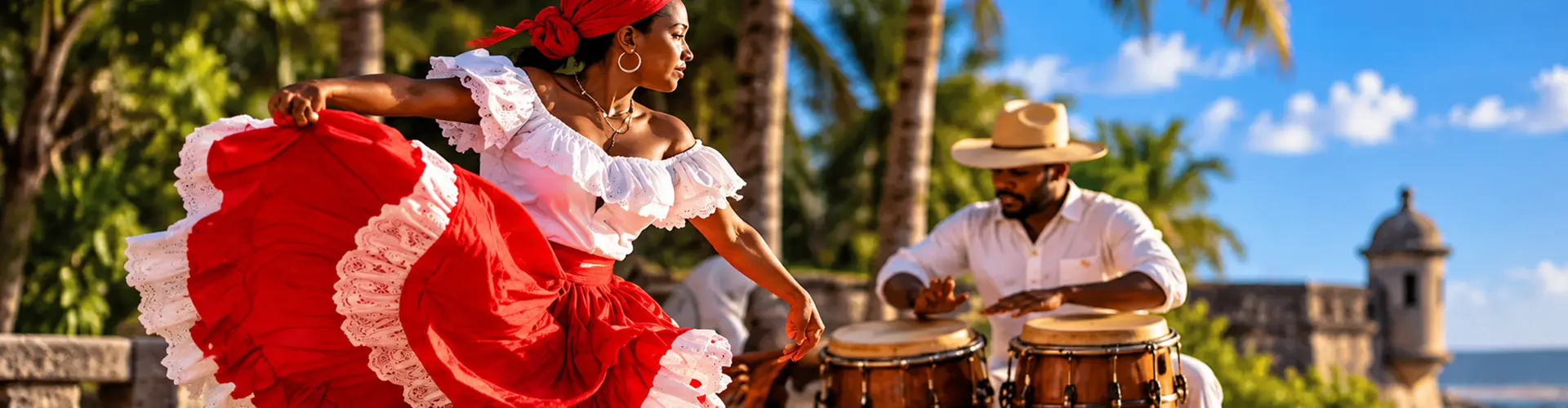
Bomba is one of Puerto Rico's oldest Afro-Puerto Rican musical traditions.
Rather than dancer simply following the drum, one of bomba's defining characteristics is the interaction between them: the lead drummer responds to the dancer's movements, creating a musical conversation.
Bomba developed within Afro-Puerto Rican communities during the colonial era and preserves powerful connections to African musical traditions. Smithsonian Folkways identifies bomba's history with enslaved Africans and their descendants in Puerto Rico.
Plena: The People's Newspaper
Plena emerged later, around the turn of the 20th century, and became another important Afro-Puerto Rican musical tradition.
Songs often commented on neighborhood events, personalities, social issues and everyday life, leading plena to become known as "el periódico cantado"—the sung newspaper.
Together, bomba and plena demonstrate how music became a means of storytelling, community expression and cultural memory.
Loíza: A Center of Afro-Puerto Rican Culture
Few places in Puerto Rico express the island's African heritage as vividly as Loíza.
Located along the northeastern coast just east of San Juan, Loíza is widely recognized as an important center of Afro-Puerto Rican culture. Generations of residents have preserved and transformed traditions expressed through music, dance, food, festivals, storytelling and art.
Bomba
Loíza is one of Puerto Rico's great centers of bomba.
During a bomba performance, singers, percussionists and dancers create a conversation through rhythm and movement. The dancer improvises piquetes—gestures and movements that the lead drummer responds to on the primo or subidor drum.
The tradition connects today's performers with generations of Afro-Puerto Rican cultural expression.
Fiestas de Santiago Apóstol
Each July, Loíza's Fiestas Tradicionales en Honor a Santiago Apóstol bring together Catholic tradition, African heritage and Puerto Rican popular culture.
Processions and celebrations fill the community with bomba and plena, colorful costumes and distinctive characters including vejigantes, Caballeros, Viejos and Locas.
The celebration itself illustrates one of the central themes of your three pages: Puerto Rican traditions often contain influences that became intertwined over centuries rather than remaining neatly separated.
The Vejigantes of Loíza
Loíza's vejigante masks are unlike those traditionally associated with Ponce.
Artisans carve them from coconut husks, adding dramatic horns and painting them in vivid colors. Ponce's famous vejigante masks, by comparison, are traditionally made from papier-mâché.
African Influence on Puerto Rican Food
African culinary traditions contributed significantly to Puerto Rican cuisine.
African heritage is deeply woven into Puerto Rico's culinary traditions. Africans brought to the Caribbean carried food knowledge, cooking techniques and culinary traditions that adapted to ingredients available in their new environment. Over generations, these practices blended with Indigenous Taíno and Spanish influences to help shape what became Puerto Rican cocina criolla.
One of the strongest influences can be seen in the importance of plantains and other starchy foods, along with techniques such as frying, pounding and preparing hearty dishes from inexpensive, locally available ingredients.
Plantains and the Pilón
Plantains became one of the most recognizable ingredients in Puerto Rican cooking. Green plantains can be fried into tostones, incorporated into pasteles, or fried and pounded to make mofongo.
Mofongo is a particularly good example of Puerto Rico's cultural mixture. Its preparation is often connected to West and Central African traditions of pounding starchy foods, while Puerto Rico's version evolved with Caribbean plantains and ingredients such as garlic and pork. The wooden pilón used to pound the plantains also has deep roots in Caribbean food preparation.
Frituras and Coastal Food Culture
African and Afro-Caribbean culinary traditions also contributed to Puerto Rico's strong culture of fried foods. Along the coast, particularly in communities such as Piñones and Loíza, frituras remain an important part of local food culture.
Alcapurrias, piononos, bacalaítos and other roadside specialties illustrate how ingredients and cooking traditions from several cultures came together over generations.
Food as Cultural Exchange
Like Puerto Rican music, the island's cuisine cannot be separated neatly into "African," "Spanish" and "Taíno" dishes.
A single dish may combine ingredients, techniques and traditions from all three. Plantains and African foodways, Indigenous root vegetables and cooking tools, and Spanish ingredients such as garlic, pork and olive oil came together in Puerto Rican kitchens.
The result is not simply a combination of older cuisines. It is cocina criolla — a culinary tradition that developed in Puerto Rico and became distinctly Puerto Rican.
Language & Everyday Culture
African heritage left its mark not only on Puerto Rico's music and food, but also on the way people communicate, celebrate and express themselves.
The enslaved Africans brought to Puerto Rico spoke languages from different regions and cultures. As people from African, Indigenous and European backgrounds lived alongside one another, their languages interacted. Over generations, these influences became part of Puerto Rican Spanish and the island's broader cultural identity. The Library of Congress describes African languages and customs as leaving an enduring imprint on Puerto Rico's evolving vernacular.
Rhythm, Speech and Oral Tradition
African influence extends beyond individual vocabulary words.
Call-and-response singing, rhythmic storytelling, improvisation and communal participation became particularly visible in Afro-Puerto Rican musical traditions such as bomba. A lead singer may improvise verses while a chorus responds, creating a musical exchange shared by performers and community.
These traditions helped preserve stories, comment on everyday life and strengthen community ties.
Music in Everyday Puerto Rican Culture
The influence extends far beyond bomba itself.
Bomba and plena helped establish rhythmic and participatory traditions that became part of Puerto Rico's broader musical landscape. Their influence can be heard within the long evolution of Puerto Rican popular music.
African Words in Puerto Rican Spanish
African languages also left traces in Caribbean Spanish. Some words used in Puerto Rico have been associated with African linguistic origins, particularly vocabulary connected with music, food and community life.
Examples often identified as having African or Afro-Caribbean roots include bomba, bembé, chévere and ñame, although the exact origins and routes by which some words entered Caribbean Spanish can be debated.
Language reflects migration. Words can travel through several countries and languages before becoming part of everyday speech, so the African origins of some Caribbean Spanish words are more difficult to trace precisely than many well-documented Taíno-derived words.
Culture Beyond Words
African heritage is also visible in dance, food preparation, festivals, craftsmanship, spirituality, family traditions and community celebrations.
A Living Language
Puerto Rican Spanish reflects centuries of contact among Spanish, Taíno, African and, later, English-speaking cultures. The way Puerto Ricans speak today is itself part of the island's history.
Art, Masks & Festivals
Afro-Puerto Rican cultural expression is particularly visible in festivals.
The colorful vejigantes associated with Loíza's Santiago Apóstol celebrations combine masks, costumes, music and community tradition.
Loíza's mask-making tradition is particularly distinctive because artisans traditionally carve masks from coconut husks, unlike the papier-mâché masks strongly associated with Ponce.
Did You Know?
Puerto Rico has two especially famous vejigante mask-making traditions.
Loíza: Masks are traditionally carved from coconut husks and are closely associated with the Fiestas de Santiago Apóstol.
Ponce: Masks are traditionally made from papier-mâché and are strongly associated with the Carnaval de Ponce.
Both feature dramatic horns, vivid colors, and fantastic faces, but their materials, craftsmanship, and local traditions give each a distinctive identity.
Afro-Puerto Rican Heritage Today
Afro-Puerto Rican heritage is not simply a chapter of colonial history. It remains a living part of Puerto Rican identity, expressed through music, dance, food, language, art, festivals and community traditions.
Bomba schools and performances introduce new generations to the tradition, artisans continue making masks and traditional crafts, and communities such as Loíza remain important centers for preserving and celebrating Afro-Puerto Rican culture.
Explore the Roots of Puerto Rican Culture
Taino Hericage ·
Spanish Heritage ·
African Heritage
Did You Know?
Puerto Rican cuisine blends Taíno, Spanish, African, and European influences, creating one of the Caribbean's most distinctive culinary traditions.
Get out Newsletter
Discover new places, local flavors, upcoming events, cultural stories, and some of our favorite finds from around the island.Read the Latest ¡La Isla! Newsletter →
Follow Along


